
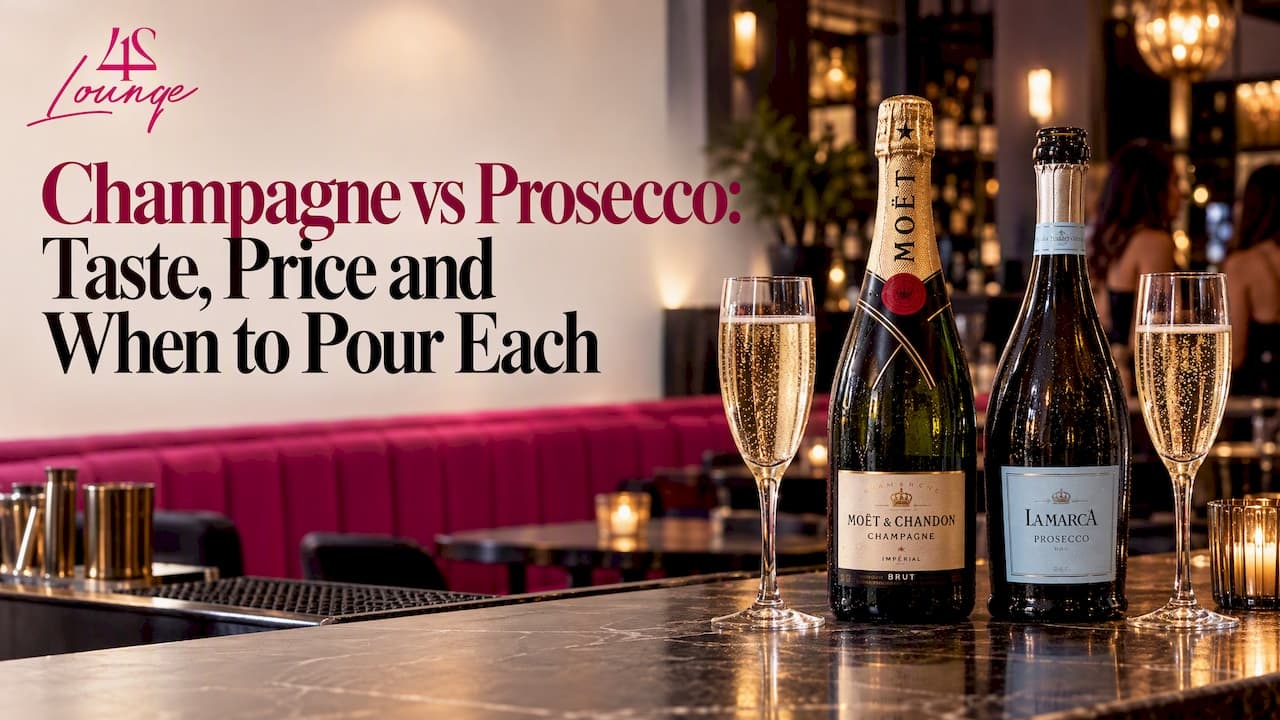
Champagne is French, made with a second fermentation inside each bottle, and tastes rich, toasty and complex. Prosecco is Italian, made in big tanks, and tastes bright, fruity and easy. That's the whole fight in two lines. Which one wins depends on your night: a toast, a cocktail, a birthday, a budget.
Below: how each is made, how they taste, what they cost in the US, where Cava fits in, and how to choose. Tu noche, your call.
TL;DR
- Champagne comes only from the Champagne region of France and is made by the traditional method, with a second fermentation in the bottle. Expect richer, yeasty, biscuit-like notes.
- Prosecco is Italian, mostly Glera grapes, made by the tank (Charmat) method. Expect lighter, fruity, floral and a touch sweeter.
- Cava is Spain's answer: made like Champagne, usually lighter, and often much cheaper.
- Price: Prosecco averages just under $18 a bottle in the US. Champagne starts around $50. Pick Prosecco for cocktails, Champagne for milestone toasts, Cava for the middle ground.
Table of Contents
- The real difference: where it's from and how it's made
- How they taste
- Is Prosecco just cheap Champagne?
- What they cost in the US
- Champagne vs sparkling wine: what's the legal line?
- Champagne, Prosecco or Cava: how to choose
- Ordering bubbles on a night out
- Birthday toast: which bottle?
- Perspective: our take on Champagne vs Prosecco
- Plan your table at 412 Lounge
- A few more bubbly facts worth knowing
- FAQ
- Sources
The real difference: where it's from and how it's made
Three things separate these bottles: place, grapes and method.
Champagne is a sparkling wine from the Champagne region of France, made by the traditional method, where the second fermentation happens inside the bottle. That's where the fine, persistent bubbles and the bakery-like depth come from.
Prosecco is Italian and made mainly from the Glera grape using the tank (Charmat) method. The second fermentation happens in a large closed tank, then the wine is bottled. It keeps the fresh fruit and skips the long bottle aging.
On the ground, Prosecco DOC is produced in north-east Italy, across Veneto and Friuli, with Glera making up at least 85% of the blend. Wines made outside the zone can't carry the Prosecco name.

Cava is Spanish and uses the traditional method like Champagne, with local grapes such as Macabeo, Xarel-lo and Parellada.
Quick comparison
| Champagne | Prosecco | Cava | |
|---|---|---|---|
| Country | France | Italy | Spain |
| Main method | Traditional (in-bottle) | Tank (Charmat) | Traditional (in-bottle) |
| Typical grapes | Classic Champagne varieties | Glera | Macabeo, Xarel-lo, Parellada |
| Flavor | Rich, yeasty, biscuit-y | Light, fruity, floral | Citrus, melon, pear, balanced acidity |
| Typical US price | Around $50 and up | Just under $18 on average | $10 to $15, with excellent bottles above $30 |
How they taste
Think of it as three vibes.
Champagne: the deep one. Time on the lees (the spent yeast) adds richness and complexity. Champagne gains biscuit-y or yeasty notes that you won't find in a fresh, tank-made wine. It's the one you sip slowly and talk about.
Prosecco: the easy one. It's lighter and less yeasty, with fruit and floral notes, and can be a little sweeter than Champagne or Cava. Think green apple, pear, white flowers. Friendly from the first glass.
Cava: the in-between. Even though it's made like Champagne, it generally spends less time on the lees. The result is a lighter style with citrus, melon and pear.
One twist worth knowing: Decanter notes that Champagne is often the benchmark for complexity, but some high-end Prosecco producers are experimenting with traditional methods and lees aging. So the old rule of thumb has exceptions. Read the label and the style.
Sweet or dry? Read the label
The word on the bottle matters as much as the region. Brut means dry. Extra dry, confusingly, is a touch sweeter. If you're mixing cocktails, a dry Prosecco keeps the drink balanced. If you love a fruity pour on its own, a slightly sweeter style will feel more generous. Not sure? Ask whoever is pouring what's driest on the list.
Is Prosecco just cheap Champagne?
No. It's a different wine made a different way, and that's why it costs less.
The tank method is faster and less labor-intensive than in-bottle fermentation, and Champagne also comes from one small, protected region. Prosecco isn't a copy trying to be Champagne. It's built to be fresh, fruity and drinkable now. The price gap reflects the process, not a quality ranking.
It's also not a niche choice anymore. Italian sparkling wine held a 30% share of the US market in the first seven months of 2025, against 28% for Champagne. Prosecco's US value hit $531 million in 2024 per the same source.
What they cost in the US
Prices swing by store, state and menu markup, but the averages tell the story.
- Prosecco: the average price of a 750 ml bottle in the US is just under $18, according to Uiv-Vinitaly Observatory data released in October 2025.
- Champagne: around $50 at the lower end, according to Bon Appétit's buying guide.
- Cava: $10 to $15 is common, and over $30 buys exemplary bottles, per the same guide.
- All sparkling wine: the average retail price was $13.14 per 750 ml bottle as of November 2025.
Those are retail numbers. Out at a lounge or club, you're paying for the bottle, the service and the setup, so the menu price will be higher. Always check the menu before you commit.
Champagne vs sparkling wine: what's the legal line?
"Sparkling wine" is the umbrella. Champagne, Prosecco and Cava all sit under it. In US federal rules, sparkling wine is grape wine made effervescent by carbon dioxide from fermentation in a closed container, tank or bottle.
Champagne is the narrower term. The TTB describes it as a semi-generic designation for sparkling grape wine that must be produced in France, unless the product was grandfathered under existing regulations. So when you see "Champagne" on a label, it's a place-based promise. Not every bubbly is Champagne, but every Champagne is bubbly.
That also covers American bottles. Chandon, for example, says Napa's warm days and cool nights, classic grapes and the traditional method produce sparkling wine that's complex yet fruit-forward. It's made in the same spirit, just not from Champagne.
Champagne, Prosecco or Cava: how to choose
Forget the snobbery. Match the bottle to the moment.
Choose Prosecco when...
- You're making cocktails. Dry Prosecco is the pick for sparkling cocktails. Spritzes, mimosas, a splash over fruit.
- You want an easy, crowd-friendly pour for a big group.
- You'd rather spend on the whole night than on one bottle.
Prosecco is also getting more cocktail love: Carlo Flamini of Vinitaly notes it is increasingly used in mixed drinks, with 40% consumer awareness in the US against Champagne's 52%.
Choose Champagne when...
- It's a milestone. Weddings, engagements and housewarmings are the classic fits.
- You want the toasty, layered style and the name on the label.
- You're pouring a toast and everyone will remember the moment.
Choose Cava when...
- You want in-bottle style without the Champagne price. The same guide points to Cava when you want Champagne but don't want to spend $40 or more.
- You like crisp citrus and pear over sweet fruit.
Cava vs Prosecco in one line
Cava is made like Champagne and tends to be crisper and more citrusy. Prosecco is made in tanks and tends to be softer, fruitier and a little sweeter. If you like dry and zippy, grab Cava. If you like fresh and fruity, grab Prosecco.

Ordering bubbles on a night out
Here's where it gets fun. A bottle at a table hits different. Sparkling wine is built for sharing, and the pop, the pour and the toast are half the experience. Preston Hunt, a wine buyer in Nashville, ties sparkling wine's growth to a shift toward lighter, bubbly, cold drinks that fit how people socialize and celebrate. Sounds like a Saturday to us.
A few moves that make ordering easy:
- Decide the vibe first. A toast for one person? Champagne-style. A table that's drinking all night? Something lighter and fresher.
- Set a per-person number. Bottle service is easier when the group agrees on a budget before you arrive.
- Ask what's dry. Brut for cocktails and food-friendly sipping, sweeter styles for dessert and fruity pours.
- Keep it cold. Bubbles lose their sparkle fast when warm.
- Plan your ride. 21+ only, and drink responsibly.
New to table service? Our guide on what bottle service is and how VIP nights work walks through it. Want the flashy part explained? See how sparkler bottle service works and the NJ safety rules before you ask for the show.
Birthday toast: which bottle?
Birthdays are the number one reason groups ask us about bubbles. Our take: let the birthday person pick the style, then let the group's budget set the size. A Prosecco-style pour keeps a big crew happy without a huge bill. A Champagne-style bottle gives you the moment for the photo and the toast.

For costs and booking steps, our breakdown of birthday bottle service in Paterson is the place to start. Planning the full night? Add the dress code basics so everyone looks the part.
Perspective: our take on Champagne vs Prosecco
We see it every weekend. Somebody wants the "fancy" bottle, somebody else just wants the table to keep the good times going. Both are right.
Our view: the best bottle is the one that fits your night. Latin and urban nights run late, the music is loud, the group is big. That's a night built for sharing, and that's why a table with bottles works so well. Everyone has a glass, everyone has a spot, and the vibe stays yours.
If you're not sure what to order, start with the group. How many people? What's the occasion? What's the budget? Tell us, and we'll help you plan it. Come for the event. Stay for the vibe.
Lorenzo
Plan your table at 412 Lounge
Ready to turn the debate into a real night? Our VIP tables and bottle service in Paterson are made for groups that want a spot, a toast and a night to remember. Celebrating a birthday? Our birthday packages come in three tiers: Silver at $375, Gold at $450 and Diamond at $550, all on the birthday celebrations page.

Want to catch live artists and DJ sets first? Check what's coming on our upcoming events page, then lock in your table. Not sure how a VIP table compares with other add-ons? Read our guide to upgrading to VIP.
A few more bubbly facts worth knowing
- Serve it cold, not frozen. Chill the bottle well ahead of time so the cork comes out gently.
- Tulip-shaped glasses keep aromas and bubbles in better than wide, shallow ones.
- Mix with intent. Save your top-shelf bottle for sipping. Use a dry, affordable sparkling wine for cocktails.
- Match the spirit. If your table mixes sparkling with liquor, our vodka vs tequila guide helps you pick your pour.
- First time out? Our first-time clubbing guide covers what to expect.
Among the 15 biggest-selling sparkling wines at retail, only five grew in both volume and dollars, and all five were priced above the $13.14 average. People are trading up for fewer, better bottles. That fits a night out too: pick one great bottle for the table over five forgettable ones.
FAQ
Is Champagne healthier than Prosecco?
Not in any way we can source. Both are alcoholic drinks, and the amount you drink matters far more than the label. Sweeter styles generally carry more sugar, so dry (brut) versions are the lighter-sugar choice. If you have a health condition or take medication, ask your doctor what's right for you.
Is Prosecco just cheap Champagne?
No. Prosecco is a separate Italian wine, mostly from Glera grapes and made in tanks, with a fruitier, lighter style. It costs less because the method is simpler and the region is larger, not because it's a knockoff.
What is poor man's Champagne?
People usually mean Cava or Prosecco. Cava is made the same in-bottle way as Champagne, and it often runs $10 to $15. We'd call it smart value, not a second-best bottle.
Can sparkling wine from outside France be called Champagne?
Generally no. Under US federal rules, Champagne is a semi-generic designation for sparkling wine that must be produced in France, with exceptions for products grandfathered under existing regulations. Everything else is simply sparkling wine.
Which is better for mimosas and cocktails?
A dry Prosecco. It's light, fruity and affordable, so it blends well without hiding behind the juice. Save the Champagne for sipping.
Sources
- Champagne vs. Prosecco vs. Cava: What's the Difference? (Food52)
- Champagne vs Prosecco: What's the difference? (Decanter)
- Wine Beverage Alcohol Manual (TTB)
- Are all bubbles the same? (Chandon)
- Champagne and Sparkling Wine Buying Guide (Bon Appétit)
- Imports, sparklers outperform in challenging wine market (Shanken News Daily)
- Vinitaly.USA: the Prosecco boom in the US
- The ultimate guide to Prosecco (The Wine Society)
- Sparkling Wines Shining Bright (Market Watch)