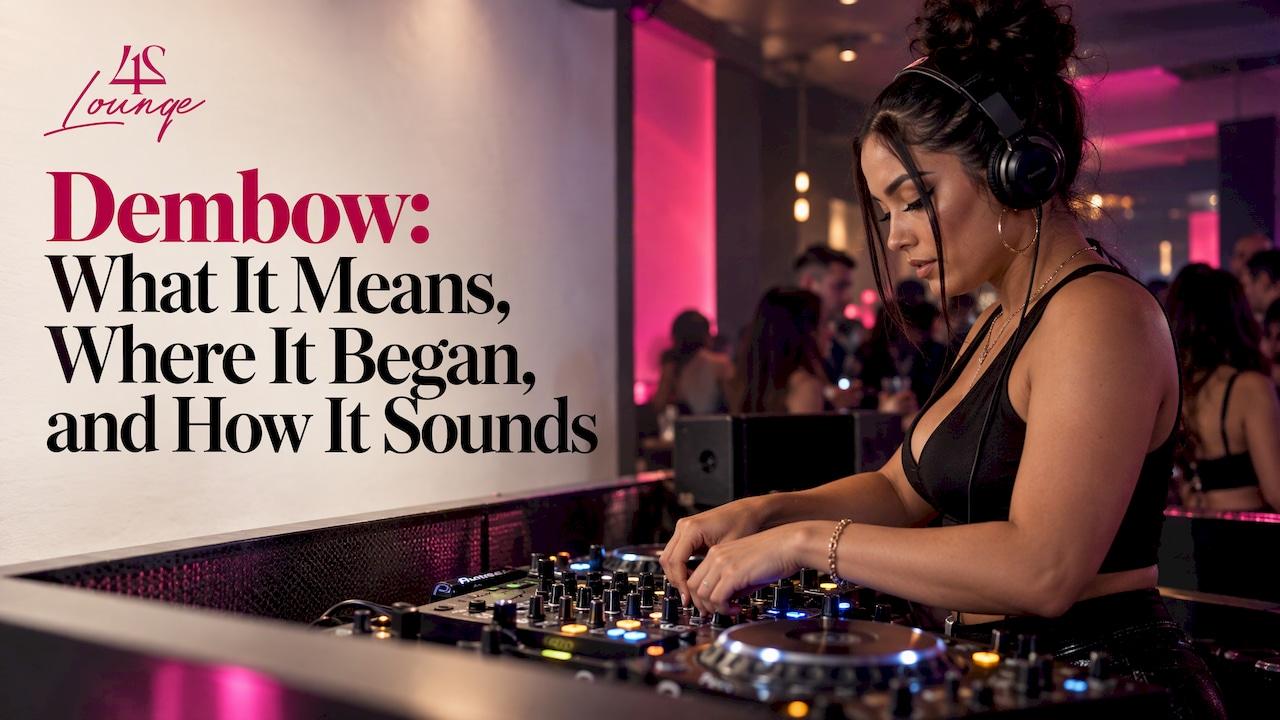
Dembow means two things. It's a drum rhythm, the "boom-ch-boom-chick" pulse under most reggaeton. It's also a fast, raw genre from the Dominican Republic built on a sped-up version of that rhythm. The word itself comes from a 1990 Jamaican dancehall song, "Dem Bow" by Shabba Ranks.
Hear it once and you'll know it. Here's the full story, plus how to catch it live in North Jersey.
TL;DR
- Dembow = a beat and a genre. The beat sits under reggaeton. The genre is Dominican, faster and rawer.
- The name is Jamaican. It takes its name from Shabba Ranks's 1990 song "Dem Bow".
- The sound: a looped, bouncing groove. Dominican dembow usually runs above 110 BPM, often around 130.
- Reggaeton vs. dembow: reggaeton is slower and more melodic. Dominican dembow is faster and percussion-first.
- Where you hear it: Latin urban DJ sets, from reggaeton classics to Dominican dembow.
Table of Contents
- What does dembow mean?
- Where dembow came from
- What dembow sounds like
- Dembow vs. reggaeton
- Dembow dance
- Why dembow matters
- Perspective from 412 Lounge
- Hear it live in Paterson
- A short dembow listening list
- FAQ
- Sources
What does dembow mean?
Start with the dictionary. In English, Wiktionary lists dembow as a noun for a genre of Caribbean popular music or a musical rhythm. In Spanish it's a masculine noun, and in slang it can simply mean reggaeton.
In real life, people use it three ways:
- The rhythm. Lowercase "dembow." The drum pattern that powers reggaeton. Fans in online reggaeton communities say the beat is what the word mostly means today.
- The Dominican genre. Often called dembow dominicano. Fast, loud, street-born. Think El Alfa.
- Old-school shorthand. For a stretch, before the word reggaeton took over, the entire Puerto Rican underground scene was simply called dembow.
So when someone asks "what is dembow?" the honest answer is: it depends who's talking and what's playing. Context tells you which one.
What the name literally meant
In Jamaican speech, "Dem Bow" is a two-word phrase, roughly "they bow." For Shabba Ranks it signaled refusing to bow, sexually or politically. Writers who have traced the term note that in the Spanish Caribbean the word rarely carries that original meaning. It became a name for a sound.
Where dembow came from
✦ Jamaica, late 1980s. The rhythm track was first used by the production duo Steely and Clevie for Gregory Peck's "Poco Man Jam" in 1989. It then appeared on the B-side of that record as "Fish Market" in 1990, and Shabba Ranks's "Dem Bow" followed the same year.
✦ Panama and New York. Nando Boom's "Ellos Benia," also known as "Dem Bow," came out in 1989. It was recorded in Long Island, where Nando Boom and producer Phillip Smart reworked the original beat into a minimal, timbales-heavy version. Across the Latin Caribbean, that is why "dembow" became the accepted name for the marching-tempo rhythm.
✦ Puerto Rico, mid-1990s. In San Juan, pioneers like DJ Playero and DJ Negro took dancehall riddims and gave them a hip-hop edge. That's the foundation of what the world now calls reggaeton.
✦ Dominican Republic, 1990s onward. DJ Boyo made what's considered the first Dominican dembow, "Mujeres Andadoras," in 1991. The scene had a rough start. It was rejected by mainstream and underground communities in its own birthplace. In 2006, Los Andolocos' "Ando Loco" became the first track to get large-scale recognition there, played in clubs nationwide.
Then the internet changed things. According to a Fordham music professor quoted in USA Today, digital platforms helped dembow push past a conservative media landscape at home, and the Dominican diaspora carried it abroad. Paterson, with its large Latin community, is exactly the kind of place where that story plays out on a Saturday night.

The 2010s: new sounds, new stars
El Alfa's "Tarzan" kicked off a new era in 2014, with new snares, trap-style keys and flute sounds. Dominican dembow then spread to Spain, the United States, Chile and Italy, as Spanish-language music grew in the 2010s and trap started shaping its production.
A lawsuit worth knowing about
In January 2023, Jamaican production company Steely & Clevie Productions filed an 82-page lawsuit in California against more than 30 reggaeton artists, alleging the beat was used without consent. The same report traces the rhythm's genesis to Jamaican church practices called pocomania in the late 1980s. It shows how deep this one rhythm runs in modern Latin music.
What dembow sounds like
Picture a loop. Kicks land steady on every beat. Snares and rimshots skip around them, so the groove leans and bounces instead of marching straight.
The technical version: the rhythm has a 3+3+2 (tresillo) cross-rhythm with slight syncopation. In one bar of 4/4, the kick hits on all four beats while the snare or rimshot hits on the last sixteenth of beats one and three, plus the "and" of beats two and four.

The simple version: boom-ch-boom-chick. Say it out loud. That's it.
Tempo: how fast is dembow?
Speed is the big tell.
| Style | Typical tempo | Feel |
|---|---|---|
| Dancehall and early reggaeton | Around 100 BPM | Slinky, grinding |
| Reggaeton (production starting point) | 85 to 100 BPM | Melodic, smooth, built for perreo |
| Dominican dembow (production starting point) | 115 to 130 BPM | Percussion-heavy, relentless |
The reggaeton and dembow ranges come from a production guide on the dembow pattern. Writers covering the scene say Dominican dembow beats are almost always faster than 110, recently around 130 and sometimes up to 150, with a pulse closer to techno. Rolling Stone described tracks that can push past 135 beats per minute, with short, sharp samples and repetitive, drilling rapping.

Dembow vs. reggaeton
This is the question behind most searches. Short answer: dembow is the foundation. Reggaeton is the house built on it.
- Reggaeton took the dembow rhythm, slowed the pace, added melody, polish and pop hooks. Berklee points out that Bad Bunny's Un Verano Sin Ti features the dembow beat throughout, and so does "Despacito."
- Dominican dembow kept it raw. As one producer told Rolling Stone, early Dominican urban music was basically a beat and vocals, a drum loop with people shouting over it. The softening and mainstream U.S. success of reggaeton skipped the Dominican scene.
The two diverged in the 2000s, as Puerto Rican reggaeton turned more melodic and polished while the Dominican scene stayed rawer.
Want a longer ear-training guide? Read our breakdown: Reggaeton vs Dembow: How to Hear the Difference.
Quick listening test
- Is the tempo closer to a walk or a jog? Walk is reggaeton. Jog or sprint is dembow.
- Is there a sung, melodic chorus? Probably reggaeton.
- Is it mostly drums, chants and fast rapping? Probably Dominican dembow.
No test is perfect. Many modern tracks blend both. That's the fun of it.
Dembow dance
Dembow dance has its own energy. It's freewheeling and joyful, grounded in Dominican traditions like dramatic torso isolation and fancy footwork. Reggaeton dance centers on perreo, the close, grinding style. Dembow's faster tempo invites something different: more soloistic moves, especially in groups.
What that means on a dance floor:
- Your crew can move together without needing a partner.
- Footwork and torso movement matter more than staying close.
- Nobody needs a routine. Catch the bounce and go.
In Dominican communities, dembow dance is also performed in cyphers and in group choreographies called animations, according to a page on the genre's cultural significance.
Why dembow matters
Historian Jennifer Motaval calls Dominican dembow "survival hood music," as reported by Billboard. The music rose organically despite barriers, and its dance moves and drum patterns carry diasporic and ancestral roots.
It's also a story about movement. Dembow started in Jamaica, traveled through Panama, New York and Puerto Rico, then found a home in Santo Domingo and the Dominican diaspora. The same rhythm keeps getting reinvented by whoever picks it up.
Perspective from 412 Lounge
We hear this question a lot, and we love it. People walk in humming a beat and want a name for it.
Here's how we see it. Dembow is the heartbeat of Latin urban nightlife. Reggaeton, dembow dominicano, and the new blends all lean on it. When a DJ drops that boom-ch-boom-chick, a room changes. Shoulders drop. Groups form. Strangers start moving together.
That's what we're built for at 412 Lounge. Latin and urban music, live artists, DJ sets, and a safe space for your people to celebrate. Our focus is on the vibe: bachata, merengue, reggaeton, dembow and more, in one night.
Learning the sound makes the night better. You'll hear the difference between a reggaeton classic and a dembow banger, and you'll know exactly when to hit the floor.
Come for the music. Stay for the vibe.
Lorenzo
Hear it live in Paterson
Tu noche starts here. 412 Lounge in Paterson, NJ is a Latin and urban nightlife venue for guests 21+, with live artist performances and dynamic DJ sets. If dembow is your sound, this is your room.
We built the night around your people:
✦ Live events. Check upcoming live events for artists and performances.
✦ VIP tables and bottle service. Get the group together and reserve a VIP table.
✦ Birthday packages. Celebrating? Our birthday celebration packages come in three tiers: Silver at $375, Gold at $450 and Diamond at $550, each a one-off price.

Not sure what to wear? We put together a guide on what to wear to the club. Curious about another North Jersey sound? Read about Jersey club music.
Ready to book? Start at 412loungepaterson.com.
A short dembow listening list
Want to train your ear before the weekend? These tracks come up in the sources above, and they show the range:
- Shabba Ranks, "Dem Bow" (1990). The origin of the name.
- Nando Boom, "Ellos Benia" (1989). The Panamanian take, recorded in Long Island.
- Luis Fonsi and Daddy Yankee, "Despacito" (2017). Its rhythm centers on dembow, and it's credited as a breakthrough for Latin music in the US.
- Bad Bunny, Un Verano Sin Ti (2022). Dembow throughout the album.
- El Alfa, "Tarzan" (2014). The Dominican sound with trap keys and flutes.
- Los Andolocos, "Ando Loco" (2006). An early Dominican club hit.
Play them in that order. You'll hear the beat speed up, get rawer, then cross back into pop.
One more tip: the DJ's tempo changes are the story of the night. Notice when a set moves from smoother reggaeton into faster dembow. That shift is when floors fill up.
FAQ
What is dembow in simple terms?
It's a rhythm and a genre. The rhythm is the looped "boom-ch-boom-chick" beat under reggaeton. The genre, Dominican dembow, is a faster, rawer style built on a sped-up version of that beat.
Who invented the dembow?
The rhythm was created by Jamaican producers Steely and Clevie, first used on Gregory Peck's "Poco Man Jam" in 1989. Shabba Ranks's 1990 song gave it the name. Dominican artists later turned it into its own genre.
Does Bad Bunny use dembow?
Yes. Berklee notes that his Grammy-winning album Un Verano Sin Ti features the dembow beat throughout. Most reggaeton leans on this rhythm in some form.
What is the difference between dembow and reggaeton?
Reggaeton is built on the dembow rhythm but is slower, usually 85 to 100 BPM, and more melodic. Dominican dembow runs faster, around 115 to 130 BPM, and puts percussion and raw vocals first.
What is dembow dance?
It's a joyful, free-flowing style with Dominican torso isolation and quick footwork. Compared with reggaeton's perreo, it often involves more solo moves, especially in groups.
Sources
- Dembow Explained (+19 Songs Featuring the Iconic Rhythm), Berklee
- Dembow beat, Wikipedia
- dembow, Wiktionary
- Dominican dembow, Wikipedia
- Hispanic Heritage Month: A Timeline of Dembow's Evolution, Billboard
- What's Dembow? All about the Dominican sound, USA Today
- The Rise Of Dominican Dembow, TIDAL
- Dembow: A Loop History, Red Bull Music Academy Daily
- "Dembow", un ritmo de iglesia que se perrea, El Espectador
- 15 Essential Reggaetón Tracks That Are Not "Despacito", Vulture
- Dembow a lo Dominicano, HyperLocal
- Dembow Took Over the Dominican Republic, Rolling Stone
- Dembow Rhythm Explained: The Pattern Behind Reggaeton