
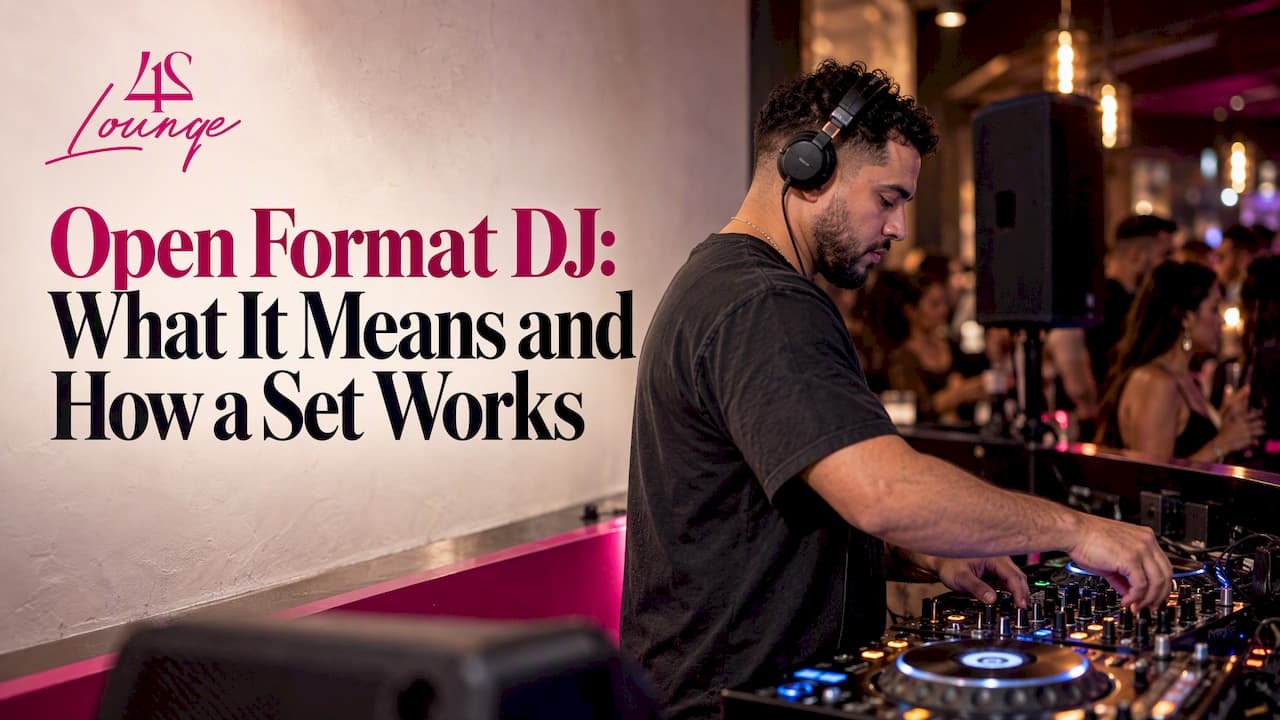
An open format DJ plays across genres in one continuous set instead of sticking to a single style. Reggaeton can roll into hip-hop, hip-hop into bachata, bachata into a throwback everyone knows. The DJ picks each track by reading the room, not by following a fixed playlist.
That's the short answer. Below is the long one: what the term really covers, why DJs argue about it, how the pros move between genres without clearing the floor, and what it means for your night out in North Jersey.
TL;DR
- Open format means multi-genre. The DJ blends styles and eras in a single set and adjusts live to the crowd.
- The core skill is reading the room: energy, tempo and mood decide the next song, not a script.
- Great transitions lean on tempo, energy and key, not on genre labels.
- Open format is not the same as "plays everything." Good DJs still build a set with a start, a peak and a release.
- Want it live in Paterson? Check our upcoming live events and bring your people.
Table of Contents
- What does "open format" actually mean?
- How an open format set is built
- The skill that matters most: reading the room
- How DJs move between genres without killing the vibe
- Open format and Latin nightlife
- What a DJ earns, and why that matters to you
- For venue owners: the licensing piece
- Our take, from the booth side of the room
- Plan your own night in Paterson
- How to pick a night with a great DJ
- FAQ
- Sources
What does "open format" actually mean?
The phrase comes from DJ booking culture. A DJ who is "open format" will perform a set built on any given format of music, rather than specializing in one sound. Think of a DJ who might open with reggaeton, move through hip-hop and pop, and land on a bachata everyone sings along to.
You'll also hear "multi-genre" or "genre-fluid." They overlap heavily. Some DJs draw a fine line: a genre-fluid DJ might pick a subtle but real difference in how much is planned versus improvised. For a guest on the dance floor, the practical meaning is the same. Variety, flow, no dead air.
Why the term is a little fuzzy
If you read DJ forums, you'll find people calling the label imprecise. They have a point. "Open format" says what a DJ is not (locked to one genre) but not what the DJ is. Two open format DJs can sound nothing alike. One might be all Latin urban, throwbacks and hip-hop. Another might jump from house to disco to pop.
That's why the best way to judge any DJ is to hear a set, not read the label. Look at the crowd. Are people still dancing when the genre changes? That's the test.
Open format vs. genre-specific DJing
| Genre-specific DJ | Open format DJ | |
|---|---|---|
| Music | One style (say, only house or only dembow) | Several styles and eras in one set |
| Crowd | Fans of that sound | Mixed ages, tastes and backgrounds |
| Planning | Often a tighter, curated flow | Flexible, adjusted live |
| Core skill | Depth in one sound | Range plus crowd reading |
| Typical rooms | Specialist nights, festivals | Lounges, nightclubs, weddings, corporate events |
The industry treats open format as the standard for versatile events where the audience varies in age and taste: nightclubs, weddings, corporate functions.

How an open format set is built
It sounds free-form. It isn't. Pros talk about the "architecture" of a set: build, peak, release. The music changes, but the shape stays.
- Build. Early in the night, the DJ warms the room. Familiar, groovy tracks. Nothing that demands full energy yet.
- Peak. The floor is full. Bigger songs, faster transitions, the tracks the whole room knows.
- Release. A breather. A slower groove, a singalong, something that lets people reset before the next push.
- Repeat. A long night has several waves. The DJ loops through them as the crowd changes.
A good DJ also keeps the room's demographic in mind. A birthday group, a date night and a crew of friends out after work all want slightly different things at different moments.
Crates, cues and instant pivots
How do DJs switch gears so fast? Preparation. Experienced DJs keep groups of songs for different vibes, such as a "Latin Urban" crate or a "Classic Throwback" crate, and set hot cues or memory points ahead of time. That means no frantic scrolling when the room reacts. If people go wild for a dembow track, the DJ already knows where the next one is.
The skill that matters most: reading the room
Technical mixing matters. Crowd reading matters more. Nightlife operators and DJ educators stress that a venue hires a DJ for crowd retention: keeping people on the dance floor and spending time (and money) in the room. Following a rigid setlist is the opposite of that.
What does reading the room look like?
- Watching the floor. Who's dancing, who's drifting to the bar, who's filming a song on their phone?
- Reading energy, not just taste. A packed floor at 1 a.m. can take a harder drop. A half-empty one at 11 might need a groove.
- Reacting fast. If a track dies, the next one fixes it. No ego about the plan.
- Knowing the culture. In a Latin room, a well-timed bachata or merengue can pull the whole place together in a way a generic pop hit can't.
How DJs move between genres without killing the vibe
This is where open format earns its reputation as one of the most demanding disciplines in DJing. Switching from one genre to another can feel jarring if you get it wrong. Here's how the good ones do it.
Bridge on tempo, energy and key
Experts advise treating genres less like walls and more like neighbors, using tempo, energy and key as the connecting points. Two songs from different genres can sit side by side if they share a similar speed and feel.
Use "momentary" transitions
Not every switch needs a smooth beat-matched blend. Between styles like Afrobeats and Latin urban, experienced DJs often drop the volume, add an echo, or phrase out rather than force two beats together. It sounds cleaner, and the crowd barely notices the seam. They just notice the next song hitting.
Match the vibe, not only the BPM
The difference between average and great is rarely library size. It's the ability to use small tricks, such as shifting EQ or timing a change at the end of a phrase, to pivot between reggaeton, dembow and hip-hop without jarring the room. The best transitions often come from matching the feel of the room, not a number on a screen.
A quick example
Picture a Saturday night. The floor is full on a reggaeton run. The DJ senses people want a singalong, so they phrase out, cut the volume for a beat, and drop in a bachata everyone knows. The room cheers. Ten minutes later, the energy is back up, and a hip-hop throwback takes over. That's open format working the way it should.

Open format and Latin nightlife
Latin nights are a natural home for this style. The sound itself is a family: reggaeton, dembow, bachata, merengue, Latin trap and more. Crowds in these rooms tend to be mixed, with some people there for the newest dembow and others waiting all night for their favorite merengue.
A DJ who can move between those worlds, and add hip-hop, R&B or pop when the moment calls for it, keeps everyone in the room. North Jersey also has its own sound. If you're curious about a regional style that often sneaks into mixed sets, read our guide to Jersey club music.
What a DJ earns, and why that matters to you
People search "is $100 an hour good for a DJ?" and the answer depends on the gig. Based on one 2026 industry guide, nightlife residencies often pay a standard local rate around $100 per hour, while private events and weddings pay more. Wedding packages average roughly $1,800 per event, and non-wedding private events typically range from $75 to $200 per hour.
Why should a guest care? Because rates track skill and demand. The DJs who can hold a mixed room for hours, and keep it spending, are the ones venues fight to book. Open format range is a big part of that value.
For venue owners: the licensing piece
If you run a bar or lounge, the music has a legal side. Venues that host live music or DJ sets in the US generally need public performance licenses from performance rights organizations such as ASCAP, BMI and SESAC. A personal streaming subscription doesn't cover it. The city of Boston explains that businesses playing music for the public have obligations here, and the Texas governor's office offers a plain-language guide: if customers can hear music at your business, including DJs, playlists and streaming, you may need licenses.
The responsibility typically falls on the venue, not the performer. Costs vary with venue size and entertainment type. If you operate a venue, ask your licensing office or an attorney what applies in your state and city.

Our take, from the booth side of the room
We run a Latin and urban lounge in Paterson. Live artists, DJ sets, VIP tables, birthday packages. Here's how we see open format.
The label matters less than the result. What you want from a night out is simple: a room that moves. A DJ who knows when to push, when to pull back and when to give the crowd the song they've been waiting for makes that happen.
For a Latin and urban room, that means respecting the music first. Bachata, merengue, reggaeton, dembow and Latin urban sets each have their own pulse and their own fans. The magic is in how they connect. Come for the event. Stay for the vibe.
It also means knowing who's in front of you. A birthday group has different moments than a date night. A table of friends wants the song that makes them scream. The best DJs feel that and respond.
— Lorenzo
Plan your own night in Paterson
✦ Tu noche starts here. ✦
Want to hear a live set instead of reading about one? Here's how to make it happen.
- See what's coming. Our upcoming live events page lists live artist performances and DJ nights. Entry is 21+.
- Get a table. Going with a crew? Reserve VIP tables and bottle service so your people have a spot all night.
- Celebrate a birthday. Our birthday packages come in three tiers: Silver at $375, Gold at $450 and Diamond at $550, each a one-off price.
- Dress the part. Not sure what to wear? Read our dress code guides for women and men.
You can also start from our home page to see everything in one place.
How to pick a night with a great DJ
Whether you come to us or go elsewhere, a few checks help.
- Look at the lineup, not just the venue. Check who's spinning and whether the night leans Latin, urban or mixed.
- Listen first. Find recorded sets or social clips. Does the DJ keep a steady energy while changing styles?
- Match the night to the group. Birthday? Date night? Reggaeton fans? Pick the night that fits.
- Arrive for the build. The early part of the night is when the DJ sets the tone. Showing up for it often means a better table, a better spot and a better peak.
- Request smart. If you ask for a song, pick one that fits the moment. Good DJs appreciate reads on the room, not a playlist handed over.
FAQ
What is an open format DJ?
An open format DJ mixes multiple genres and eras in one continuous set instead of specializing in one style. Hip-hop, reggaeton, pop, house and throwbacks can all appear in the same night. The DJ chooses tracks based on what the crowd is doing.
What is open format music?
There's no single "open format" genre. The term describes a mixed approach to selecting music, not a sound of its own. A set might include whatever the room responds to, from current hits to older favorites, as long as it flows.
Is open format DJing harder than playing one genre?
Many DJs and educators say yes. It requires working knowledge across many genres, plus the ability to transition between them and read a crowd in real time. A specialist can go deep on one sound. An open format DJ needs range and judgment.
Is $100 an hour good for a DJ?
It's a common local rate for nightlife residencies, according to a 2026 industry guide. Private events pay more, often $75 to $200 an hour, and weddings average higher per event. Whether it's "good" depends on experience, venue and how many hours of prep go into the night.
Can I hear Latin DJ sets in Paterson?
Yes. We host live artists and DJ nights at 412 Lounge, with Latin and urban music at the center. Visit our events page for what's coming up. Guests must be 21+.
Sources
- Open Format DJs for Hire | DropTheBeat
- Open Format DJing. What is it?
- Open Format DJ Guide: Tips, Tricks, and Techniques | DJ.Studio
- The Power of 6: How to Build a Fail-Proof Wedding Set
- How to Get Your First DJ Gig (and What to Charge for It) | Digital DJ Pool
- Open Format DJ Transitions | VickNick Video Pool
- Avoiding copyright infringement | Boston.gov
- Music Licensing for Your Business | Texas.gov