
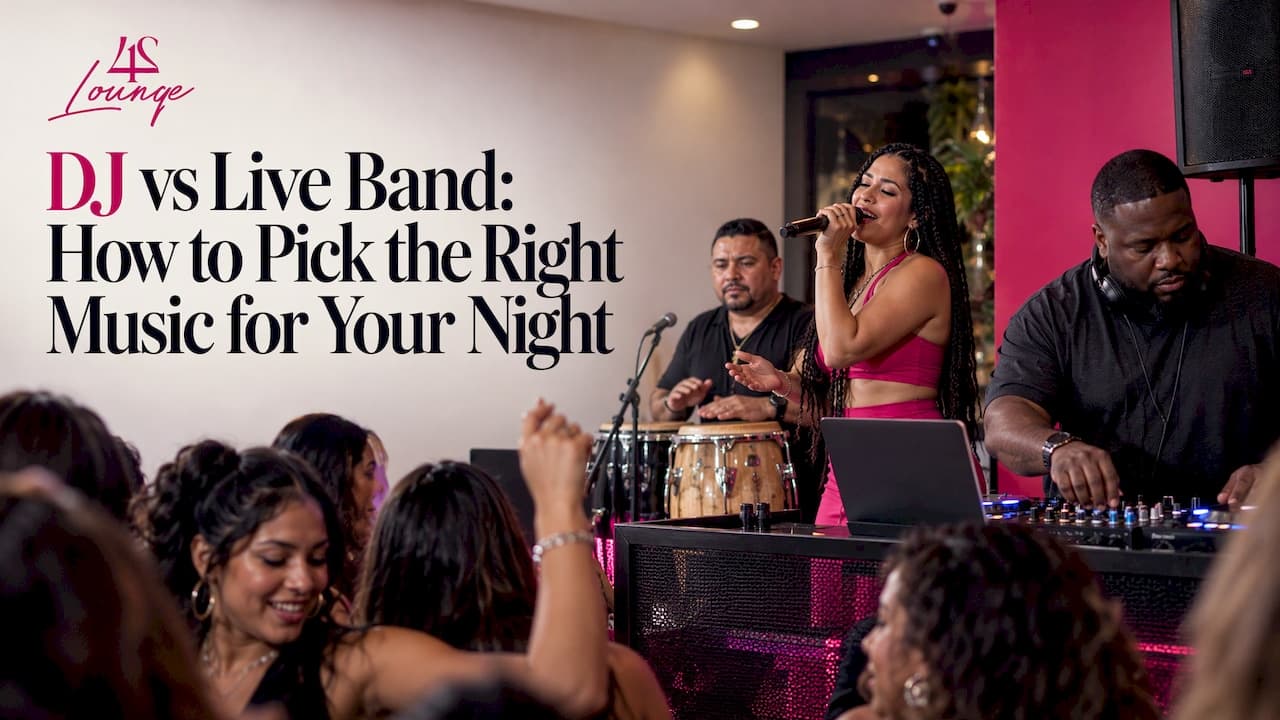
Short answer: pick a DJ when you want nonstop dancing, the widest song range and a tighter budget. Pick a live band, or a live artist, when you want a spectacle and a moment your whole crew will talk about. Pick both when you can. Same night. Same room. Different energy at different hours.
That's the whole debate. The rest of this guide breaks it down: how each one feels on the floor, what each costs, what each needs in space and gear, and how to mix them. We'll also show how this plays out at a Latin and urban lounge, where bachata, merengue, reggaeton and dembow can all hit in a single hour.
TL;DR
- DJ: unlimited song choice, no gaps in the music, a small footprint and, on average, a lower price.
- Live band or live artist: real people, real peaks, a shared moment. Expect set breaks and a smaller song list.
- Cost: The Knot's national averages are $4,500 for a wedding band and $1,800 for a wedding DJ. Nightlife pricing works differently, but the gap in format costs is the same story.
- Best of both: a live performance as the headline moment, a DJ before, between and after. That's how a big night stays loud from open to close.
Table of Contents
- What actually separates a DJ from a live band
- Energy and atmosphere: what the dance floor feels
- Song variety and requests
- Space, gear and breaks
- What each one costs in the U.S.
- The hybrid: when you don't have to choose
- Matching format to your night
- Our take
- Make it your night at 412 Lounge
- FAQ
- Sources
What actually separates a DJ from a live band
A DJ plays recorded music for an audience. Per the U.S. Department of Labor's O*NET, a disc jockey (except radio) plays prerecorded music for live audiences at clubs, parties or receptions, and may mix, cut or sample recordings. Club DJs also blend tracks so the music flows without a stop, as Wikipedia describes. Good ones also work the mic and hype the room.
A band is a small group of musicians who play popular music together, often with a singer, as the Oxford Advanced Learner's Dictionary puts it. Nothing is pressed play. Everything happens live.
So the real difference isn't "old school vs new school." It's this:
- A DJ curates. One person reads the room and picks from every song ever recorded.
- A band performs. Several people create the sound in front of you, and the crowd feeds the energy back.
Neither one is better by default. Each one is better at something.
Energy and atmosphere: what the dance floor feels
✦ The DJ vibe: steady, controlled, nonstop
A DJ keeps the floor moving with no breaks. According to The Music Bureau's 2026 guide, one DJ can go from a grandparent's favorite to a teenager's without a rehearsal, mixing decades and genres in a single hour. For a Latin night, picture a smooth run from bachata into merengue, then a hard turn into reggaeton and dembow. No pause. No dead air. If you want to hear how those last two differ, see our breakdown of reggaeton vs dembow.
✦ The live vibe: peaks, risk and shared moments
A band or live artist creates peaks. The same guide says a band is better when you want spectacle and shared moments. A singer working the crowd, a live percussion break, a sing-along that gets the whole room shouting: that's the part no playlist can copy. Troy Curtis Entertainment puts it as a DJ playing music while a band creates an atmosphere, with an emotional arc across the night.
Here's the honest trade: a DJ's strength is control, and a performance's strength is the unpredictable, in-the-moment feeling. Great nights use both.
Who is in the room matters most
Before you choose, picture your people:
- Mixed ages and tastes? A DJ covers more ground.
- A crowd that came for one artist? Live is the main event.
- A birthday with 15 friends who all want different songs? A DJ takes requests and flips the vibe in seconds.
- A big celebration you want everyone to film? Live performance gives you the moment.
Song variety and requests
This is where a DJ wins, and it isn't close. uRequest Live's comparison notes that a DJ can play any track that exists in digital form, while a traditional band sticks to a rehearsed list of roughly 40 to 80 songs. Request-style bands stretch that to 500 or more, but a DJ library is still bigger.
For Latin and urban nights, that range is the point. A typical Latin party can move through salsa, bachata, merengue, cumbia, reggaeton and more alongside English-language hits, and the DJ reads the floor and adjusts the balance in real time so transitions feel natural. In the New York and New Jersey area, DJs who work this way blend Caribbean sounds like bachata, salsa, merengue and dembow with reggaeton, Latin trap and cumbia without missing a beat.
Want to understand how a DJ builds a night around many genres at once? Read our guide to what an open format DJ does. And if Jersey's own sound is on your list, we covered Jersey club music too.

Space, gear and breaks
Practical stuff decides more nights than people expect.
Footprint
A DJ needs a table and a short signal chain. Primal-Sounds describes a laptop or media player into a controller into the PA. A band needs many separate inputs. The same source says a six-piece band can need 16 to 24 channels, plus a digital mixing console, microphones, monitors and an experienced sound tech. Paperlust pegs the space difference at about 4 to 8 square feet for a DJ against 15 by 20 feet or more for a five-piece band.
Breaks
This one changes the flow of a night. Paperlust says bands typically take set breaks of 15 to 20 minutes per hour. Genesis Events adds that the recorded music that fills those breaks is where dance floors tend to empty, while a DJ can play continuously for hours.
| DJ | Live band | |
|---|---|---|
| Song range | Essentially unlimited | Rehearsed list, often 40 to 80 songs for a traditional band |
| Breaks | None, continuous music | Roughly 15 to 20 minutes per hour |
| Space | A table and gear | A stage, often 15 by 20 feet or more for five players |
| Sound setup | Short signal chain | Many inputs, monitors, a sound tech |
| Feel | Polished, controlled | Spontaneous, theatrical |
| Typical cost | Lower | Higher |
If your room is a lounge with a dance floor that needs to stay full, those numbers matter. Less stage, fewer gaps, more floor.

What each one costs in the U.S.
Here's what we can source. These are wedding figures, because that is where national data exists, but they show how the two formats compare.
The Knot's study reports national averages of $4,500 for a live band and $1,800 for a DJ. The spread inside each category is wide:
| Tier | Band | DJ |
|---|---|---|
| Lower quartile average | $900 | $800 |
| Median average | $1,900 | $1,600 |
| Upper quartile average | $7,000 | $2,700 |
The Knot also says cost moves with set length, number of musicians, how much tech is needed, travel fees and custom requests. In North Jersey and the wider mid-Atlantic, one regional write-up citing The Knot's 2026 study puts averages higher, around $2,500 for a DJ and $7,300 for a band.
Why the gap? More people to pay, more gear to move, more setup time. A DJ is one person with a compact rig.
What does this mean if you're not hiring anyone, just going out? It means the venue's format decides your night. A lounge built around DJ sets and booked live artists can put both in front of you without you paying either bill. You pay for your table, your tickets or your package.

The hybrid: when you don't have to choose
Can you combine a live performance and a DJ? Yes, and it's common. Primal-Sounds describes events where the band plays the early part and the DJ takes over for the late-night dance party, with the sound tech crossfading so there's no dead air or awkward cable swap. The Knot also mentions fusion acts that put a DJ at the center and add live instruments like guitars, drums and horns. And Genesis Events describes hybrids where the DJ never stops and musicians play over the set in bursts.
How the night can flow:
- Doors and early hours: DJ sets the vibe and fills the floor.
- Peak hour: live artist or performer takes the spotlight.
- Handoff: DJ picks up the energy immediately, no gap.
- Late night: DJ runs the room until close.
That structure keeps the best of both. The moment you remember, and the floor that never cools.
Matching format to your night
Use this quick guide.
- Birthday with a big friend group: DJ-led night, with a table so your people have a home base. Our post on birthday bottle service in Paterson covers how booking works.
- Date night with dancing: a DJ night with a Latin-heavy mix keeps you on your feet from the first song.
- You came for one artist: go on a live event night and arrive early.
- First time out in Paterson: check the dress code for men or the dress code for women before you go.
Planning a trip to a bigger concert, too? Presale timing matters, and concert ticket presale guides can help you get ahead of the rush for stadium and arena shows.
Our take
We don't see DJ vs live as a fight. We see it as a menu.
A DJ gives you range. Bachata, merengue, reggaeton, dembow, Latin urban, all in one night, all flowing. A live artist gives you a peak. The moment the room lifts and everybody pulls out their phones.
That's why 412 Lounge is built around both: live performances from artists, and dynamic DJ sets. Come for the event. Stay for the vibe.
Our advice? Bring your people, grab a table, and let the night move. The DJ sets the pace. The performance makes the memory. Tu noche, your way.
Lorenzo
Make it your night at 412 Lounge
Ready to hear the difference instead of reading about it? 412 Lounge in Paterson, NJ, is a 21+ Latin and urban nightlife spot with live artist performances, DJ sets, VIP tables with bottle service and birthday packages.

Celebrating? Our birthday packages come in three tiers: Silver at $375, Gold at $450 and Diamond at $550. See what each includes on the birthday celebrations page. Want a table for the crew? Check VIP tables and bottle service. Not sure what bottle service even is? Start with our bottle service guide, and if you want the sparkler moment, read about sparkler safety and NJ rules. To see who's performing, head to upcoming live events.
FAQ
Is a DJ or a live band better for dancing?
A DJ is usually better for nonstop dancing, because the music never stops and the DJ can switch genres instantly. A band delivers bigger peaks and shared moments but takes set breaks. Many nights work best with a live moment surrounded by DJ sets.
How much is a band vs a DJ?
Nationally, The Knot reports averages of $4,500 for a live band and $1,800 for a DJ for weddings. Prices climb with set length, number of musicians, equipment and travel. Your own cost at a lounge depends on the table, ticket or package you choose.
What qualifies as a DJ?
A DJ plays recorded music for a live audience at places like clubs, parties and receptions, and may mix, cut or sample tracks, according to O*NET. Many DJs also act as emcee, hyping the crowd between songs.
What is a live band?
It's a small group of musicians playing popular music together, often with a singer, as defined by the Oxford Advanced Learner's Dictionary. Everything you hear is performed in the moment, not played back from a recording.
Can I get both in one night?
Yes. Hybrid nights have a live performance as the highlight and a DJ covering the rest, so the floor stays full. Check our events page to see what's coming up at 412 Lounge.
Sources
- The Average Cost of Hiring a Band or DJ for Your Wedding, The Knot
- How to Decide Between a Live Band vs. a DJ for Your Wedding, The Knot
- Disc Jockeys, Except Radio, O*NET OnLine
- Disc jockey, Wikipedia
- Band, Oxford Learner's Dictionaries
- Wedding DJ vs Live Band: Sound System Guide 2026, Primal-Sounds
- Wedding Band vs DJ: Cost, Pros & Cons, Paperlust
- Wedding DJ vs Live Band, Genesis Events
- How to Choose Between a Live Band or DJ, The Music Bureau
- Wedding Band vs DJ: The Complete Guide, Troy Curtis Entertainment
- Live Band vs DJ for Your Event, uRequest Live
- Latin Wedding DJ Raleigh NC, Triangle DJ
- DJ Kandela, Latin DJ for Hire
- Band vs. DJ in NJ, Liza and Josh