
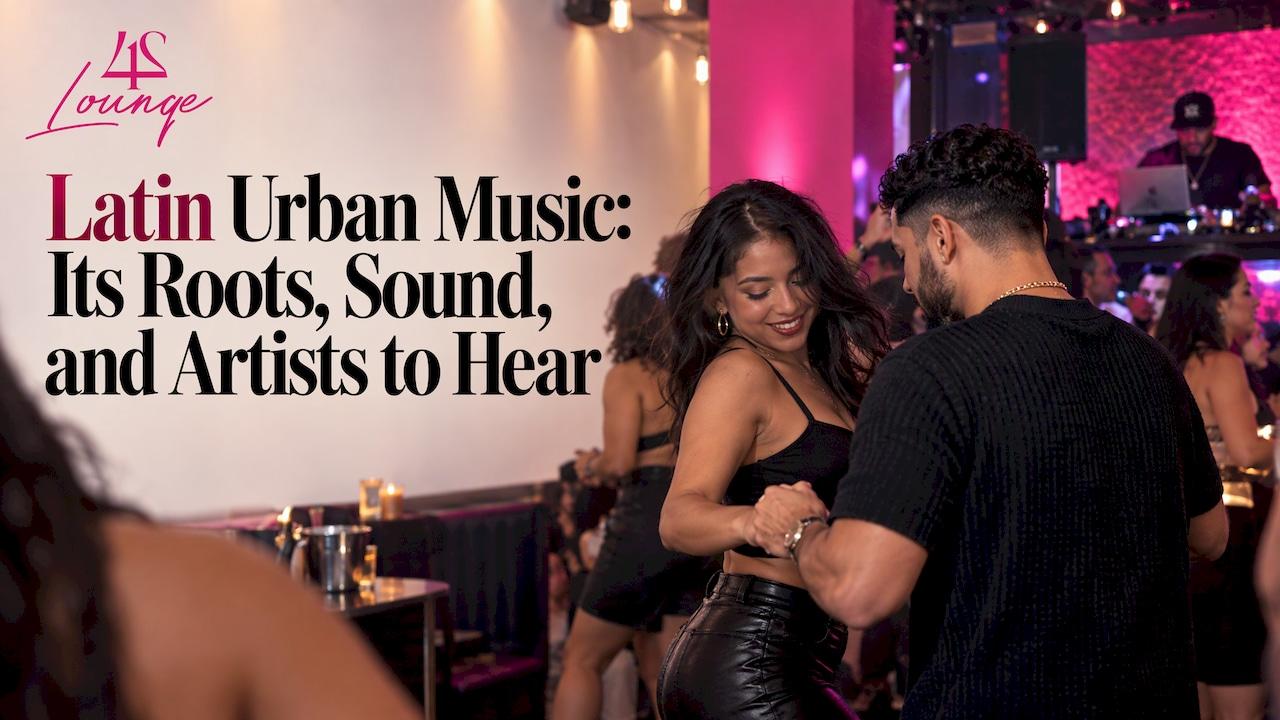
Latin urban music (música urbana, or urbano) is an umbrella term for Spanish-language music built on Caribbean and hip-hop rhythms. It covers reggaeton, dembow, Latin trap, Latin hip-hop and more. It started in marginalized communities in Latin America and its diaspora, and today it fills streaming charts, radio and dance floors across the US. Here is the full picture, from the beat to the artists to the night out.
TL;DR
- Latin urban is a family of genres, not one sound: reggaeton, dembow, Latin trap, Latin hip-hop, dancehall-rooted styles and more.
- The roots run through 1980s Panama and 1990s Puerto Rico, where Jamaican dancehall met U.S. hip-hop.
- In the US, Latin music hit a record $1.4 billion in 2024 revenue, and listening keeps climbing.
- Bad Bunny, J Balvin and Daddy Yankee are good starting points. Then go hear it loud, with your people.
- In Paterson, NJ, 412 Lounge puts Latin urban DJ sets and live artists on the calendar.
Table of Contents
- What Latin urban music actually means
- The sounds under the umbrella
- Where it came from
- How the sound has changed
- Artists worth knowing
- How big is Latin urban music in the US?
- Hearing it live beats any playlist
- Perspective
- Make it your night at 412 Lounge
- Building a Latin urban night out
- FAQ
- Sources
What Latin urban music actually means
Think of it as a big tent. Under it you find reggaeton, dembow, Latin trap, Latin hip-hop, Latin R&B and other styles that grew out of the Caribbean, the Latin American mainland and their diaspora cities. One song can mix several of them.

Pitchfork's guide to the genre describes música urbana as born in Latin America's marginalized communities, in favelas, caseríos and working-class neighborhoods, and in diaspora hubs like New York and Miami. It also describes a space for pleasure, protest and romance. That mix is why one track can be a club anthem and a love song at once.
Billboard makes a similar point: the music was born in marginalized communities and gave people room to talk about racism and classism. So urbano is party music, and it is also much more than party music.
A word on the word "urban"
The label itself is debated. Petra Rivera-Rideau, author of a book on reggaetón and race in Puerto Rico, has pointed out that "urban" is not a neutral term. In a Tidal Magazine feature she notes it often signals race and class without naming them. Artists and critics keep talking about it, and many listeners simply say reggaeton, trap or dembow when they mean a specific sound. Both habits are normal. Use the word that fits the song you are talking about.
The sounds under the umbrella
Here is a quick map. You will hear most of these in a single night of a good Latin urban DJ set.
| Style | What you hear | Where it sits |
|---|---|---|
| Reggaeton | Steady dembow pulse, Spanish vocals, hooks built for dancing | The best-known core of urbano |
| Dembow | Kick-and-snare loop with a syncopated accent | The rhythm spine of reggaeton, and a Dominican style in its own right |
| Latin trap | Slower, heavier beats, melodic or rapped vocals | Grew from Southern U.S. hip-hop |
| Latin hip-hop | Rap in Spanish over boom-bap, trap or reggaeton beats | Close cousin of everything above |
| Latin R&B / pop urbano | Smoother vocals, softer production | Where radio crossovers often live |
Reggaeton and the dembow beat
The dembow beat is the engine. It is named after Shabba Ranks' 1990 dancehall song and became reggaeton's structural spine, a kick-and-snare loop with an off-beat accent. Once you can pick it out, you will hear it everywhere. We wrote a full guide on how to hear the difference between reggaeton and dembow if you want to train your ear.
Latin trap
Latin trap leans on slow-rolling rhythms and smooth, gooey vocal delivery borrowed from Southern hip-hop. Rolling Stone's reporting on the scene explains that it responds to developments in American rap. The same piece quotes a Universal Music Latino executive describing it as a counter-culture of young listeners with almost no radio play. That has changed a lot since.
Close neighbors on the dance floor
A night out rarely stays inside one genre. DJs blend in bachata and merengue, and some bring regional club sounds too. If you are curious how local sounds fit in, read our breakdown of Jersey club music, its history and dance moves. It is a North Jersey story, and it sits comfortably next to Latin urban sets.
Where it came from
The short version: Jamaica, Panama, Puerto Rico, then the world.
- 1980s Panama. Artists adapted Jamaican reggae and dancehall into Spanish, often called reggae en español.
- 1990s Puerto Rico. The "underground" scene took off. According to Coda Music's history of the era, DJs like Playero and Negro fused Jamaican dancehall rhythms with U.S. hip-hop and local street culture, passed around on cassette tapes.
- 2004. Daddy Yankee's "Gasolina" and N.O.R.E.'s "Oye mi canto" brought reggaetón to an international level, hitting the Billboard charts.
- 2017. "Despacito" by Luis Fonsi and Daddy Yankee, later remixed with Justin Bieber, is the song a Barnard-hosted academic journal credits with establishing urbano in the mainstream English-speaking US market.
- Today. Billboard's timeline traces a path from underground Puerto Rican mixtapes to commercial reggaetón and Latin trap, later adding a lighter, radio-friendly sound and R&B elements.
Producer Tainy has described one change in plain terms: conversational singing became more common than gruff rapping. That is a big part of why the sound reached so many new listeners.
How the sound has changed
The early records were raw, street-level and built for the block party. The newer wave still moves bodies, but many songs now go further into feelings. America magazine notes that modern Latin urban lyrics show more introspection and emotional openness than the party-first or street-realist themes of earlier years.
What does that mean for you on a night out? Range. A good set can go from a hard dembow banger to a sing-along ballad-style reggaeton track and back again. The crowd knows every word either way.

Artists worth knowing
You asked for names, so here is a starter list built around styles, not rankings.
- Bad Bunny. A leading Latin trap artist who has worked with reggaeton stars like J Balvin and Daddy Yankee, as the Recording Academy's Grammy site has covered.
- Daddy Yankee. The face of the 2004 breakthrough with "Gasolina."
- J Balvin. A reggaeton name that shows up on collaborations across the genre.
- Wisin & Yandel and Don Omar. Classic reggaeton voices that DJs still play for the throwback moment.
- Rauw Alejandro and Eladio Carrión. Newer-wave artists who move between R&B, trap and reggaeton.
- Tainy. A producer behind a long list of hits, worth following if you like the sound behind the voice.
A smart way to explore: pick one artist, then follow their collaborations. Urbano is a collaboration culture, so one feature leads to the next.

How big is Latin urban music in the US?
Big, and still growing. A few numbers from official industry reports:
- The RIAA reported that Latin music revenues in the US reached a record $1.4 billion in 2024, adjusted for inflation and 18% above the 2005 peak.
- In 2025, Latin music passed $1 billion in US wholesale recorded revenue again, up 4.2% year over year, and made up a record 8.8% of total US recorded music revenue.
- A Luminate midyear report covered by Rolling Stone found Spanish-language songs hit a record 9.4 percent of US streams in 2026, nearly one in ten.
The same report quotes a Luminate executive saying 54 percent of US music listeners now engage with Latin music in some way. So if your group chat is full of urbano, you are far from alone.
Hearing it live beats any playlist
Streaming is how most people find the music. A room is where it hits. A heavy dembow through a real sound system, a DJ reading the crowd, a live artist pulling the whole floor into one chorus. That is the difference.
A few tips for your first Latin urban night:
- Go with your people. The vibe is communal. Bring friends, a date or a birthday crew.
- Learn three songs ahead of time. You do not need fluent Spanish. Know the hooks and you are in.
- Ask the DJ what is coming. Many sets run open format, mixing Latin urban with other styles. Our guide to how an open format DJ set works shows what to expect.
- Plan your table early. Weekend nights fill up. Booking ahead means your spot is waiting.
- Bring ID. Our late-night events are 21+.
Perspective
Here is how we see it at 412 Lounge. Latin urban music is not a trend we picked up. It is the sound our guests grew up on, argue about and sing at full volume.
That is why we built the night around it. Live artists, DJ sets across reggaeton, dembow, bachata, merengue and Latin urban, and a space where you can dance late with people you trust. We want the room to feel safe, loud and welcoming at the same time.
A playlist can introduce you to a song. A night out lets you live it. Come for the event. Stay for the vibe. Tu noche should sound like your people, and we are here to make that happen in Paterson.
Lorenzo
Make it your night at 412 Lounge
If you read this far, you are probably ready to hear it for real. 412 Lounge in Paterson, NJ is built for Latin and urban nightlife: live performances, dynamic DJ sets, VIP tables and birthday packages, all 21+.

Here is what you can book:
- Birthday packages. Three tiers on the birthday celebrations page: Silver at $375, Gold at $450 and Diamond at $550. Check the page for what each tier covers.
- VIP tables and bottle service. Reserve through the VIP tables and bottle service page for a group night with a spot that is yours.
- Live events. See who is performing on the upcoming live events page. Schedules change, so that page is always the source of truth.
Ready to celebrate? Head to 412 Lounge Paterson and lock in your night.
Building a Latin urban night out
Whether it is a birthday, a date or a Friday with the crew, a little planning makes the night smoother.
For a birthday
Pick your tier early and tell your group the plan. A birthday works best when everyone knows when to arrive and who is bringing what energy. Our three packages are pre-paid, so the money question is settled before the night starts.
For a group night
A VIP table gives the group a home base. You can leave to dance and come back to your spot. If your crew has mixed tastes, that is where open format sets help: a bit of bachata for the couples, dembow for the floor, trap for the back row.
For a date night
Latin music is made for two. Bachata and merengue are classic partner dances, and reggaeton works for a looser, closer kind of dancing. Nobody needs lessons. Follow the rhythm and your partner.
For a solo or newcomer night
Come curious. Latin urban crowds tend to be social, and a good DJ will bring everyone into the same chorus. Learn a hook, find the floor, and let the beat carry you.
FAQ
What is Latin urban music?
It is an umbrella term for Spanish-language music rooted in Caribbean, hip-hop and dancehall sounds, including reggaeton, dembow, Latin trap and Latin hip-hop. Pitchfork's guide traces it to marginalized communities across Latin America and its diaspora. The styles overlap, so one song can be several things at once.
Who are some popular Latin urban artists?
Bad Bunny, J Balvin, Daddy Yankee, Wisin & Yandel, Don Omar, Rauw Alejandro and Eladio Carrión are all good entry points. Producer Tainy is worth following too. Start with one artist and trace their collaborations to find more.
What is the difference between reggaeton and Latin urban music?
Reggaeton is one genre inside the Latin urban umbrella, defined by the dembow rhythm. Latin urban also includes Latin trap, Latin hip-hop and other styles. Every reggaeton track is Latin urban, but not every Latin urban track is reggaeton.
Where can I hear Latin urban music live in North Jersey?
Check the 412 Lounge events page for current live artists and DJ nights in Paterson. Entry is 21+. For a group night or birthday, you can reserve a table or package ahead of time.
Sources
- Urbano Music in 50 Songs: An Introduction to Reggaeton (Pitchfork)
- Vico C & Chencho Corleone interview (Billboard)
- Latin Music's 'Urbano' Reckoning (Tidal Magazine)
- The Cassette Tapes That Built Reggaeton (Coda Music)
- Inside Latin Trap, the Viral Sound Too Hot for Radio (Rolling Stone)
- Urban Genres in Puerto Rico (Acceso, University of Puerto Rico)
- Nuestra Señora del Mal Querer (The Scholar & Feminist Online)
- Música Urbana Is the Most Important Wave In Pop Right Now (Billboard)
- How Puerto Rican Producer Tainy Became an Architect of Pop (Rolling Stone)
- Reggaeton can reveal God to us (America Magazine)
- How Bad Bunny Is Putting Latin Trap On The Map (Grammy.com)
- Latin Music generated over $1 billion in US wholesale recorded music revenues in 2025 (Music Business Worldwide)
- Bad Bunny, BTS Spike Non-English Streaming Numbers (Rolling Stone)