
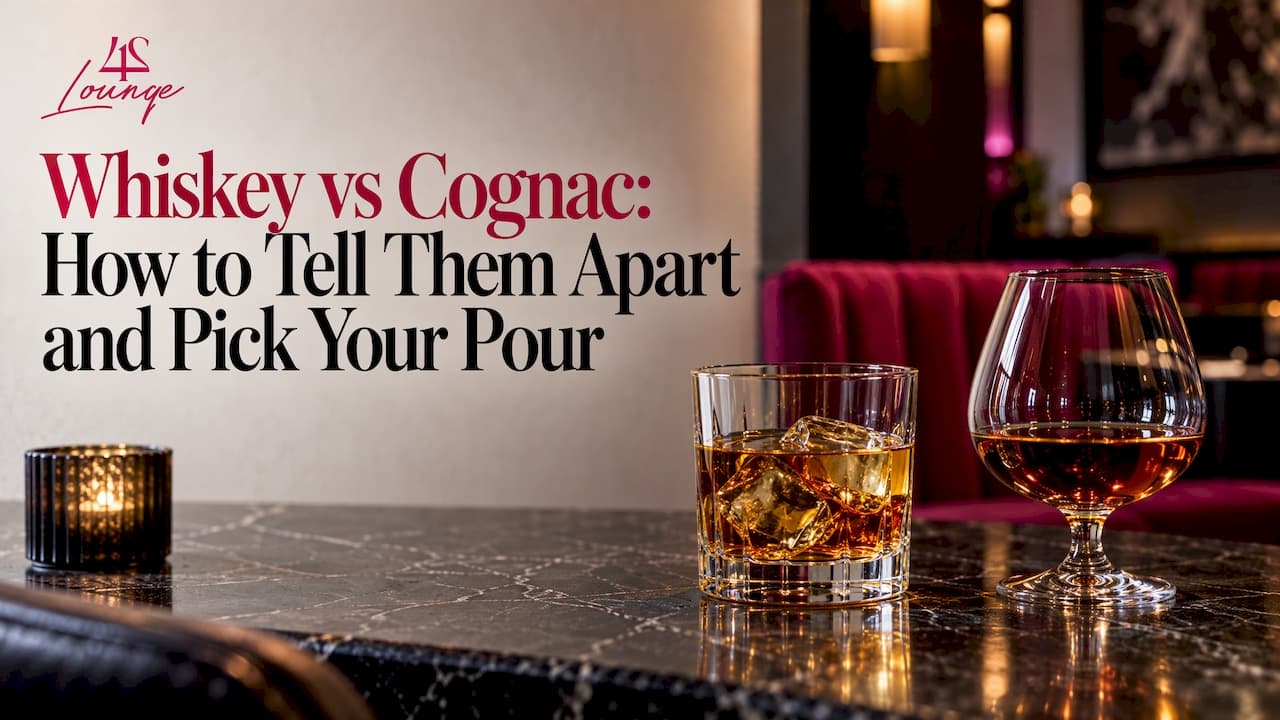
Whiskey comes from grain. Cognac comes from grapes. That is the whole split, and everything else (flavor, price, the way you sip it) grows out of it. Whiskey is a broad family that runs from smoky Scotch to sweet corn-led bourbon. Cognac is one tightly regulated type of brandy from one corner of France. Both land in an amber glass. Both can make your night. Here is how to choose.
TL;DR
- Whiskey is distilled from fermented grain (barley, corn, rye, wheat). Cognac is distilled from wine made of white grapes, and it is a type of brandy.
- Cognac has to come from the Cognac region of France, be distilled twice in copper pot stills and age at least two years in oak. Whiskey rules change by style and country.
- Expect fruit, flowers and oak spice from cognac. Expect anything from smoke to toffee to vanilla from whiskey.
- Both are typically bottled at 40% ABV or more, so a standard pour carries the same amount of alcohol.
- Going out with a group? Pick by vibe: whiskey for bold and familiar, cognac for smooth and celebratory.
Table of Contents
- The short answer: grain versus grapes
- Whiskey vs cognac at a glance
- How whiskey is made
- How cognac is made
- Reading the label: VS, VSOP, XO
- Where brandy fits in
- How they taste
- Why cognac costs what it costs
- Strength, standard drinks and pouring smart
- Hennessy: whiskey or cognac?
- Which one to pour on your night
- Perspective
- Make it a table night
- FAQ
- Sources
The short answer: grain versus grapes
Ask any distiller and you get the same line. Whiskey is distilled from grain, while brandy is distilled from wine or fermented fruit. Common whiskey grains are barley, corn, rye and wheat. Brandy is usually made from white grapes and is typically aged in barrels.
Cognac sits inside the brandy category. Cognac is a brandy made from grapes in a strictly regulated region of western France. So cognac is never a whiskey. It is a cousin that happens to share the oak barrel and the golden color.

That shared look is why people mix them up. Your eyes say the same thing. Your nose and tongue do not.
Whiskey vs cognac at a glance
| Whiskey | Cognac | |
|---|---|---|
| Made from | Fermented grain mash | Wine from white grapes |
| Type of spirit | Whiskey (many styles) | Brandy (one regulated style) |
| Where | Anywhere, with style rules (Scotland, Kentucky, Ireland and more) | Cognac region, western France only |
| Distillation | Varies by style | Twice, in copper pot stills |
| Minimum aging | Varies; straight bourbon needs 2 years | 2 years in oak (VS) |
| Minimum strength | 40% ABV in the US | 40% ABV |
| Typical flavor | Smoke, toffee, malt, vanilla, spice, nuts | Stone fruit, flowers, citrus, vanilla, caramel, oak spice |
The sections below back up each row.
How whiskey is made
Whiskey starts with a mash of grain. The ratio of grains is called the mash bill, and it shapes the spirit. Bourbon must use at least 51 percent corn, rye at least 51 percent rye, and single malt Scotch is 100 percent malted barley.
In the US, the rules are written down. Straight bourbon must come from a mash of at least 51% corn, be stored in charred new oak barrels, and age a minimum of 2 years, with no coloring or flavoring added. That charred barrel is where much of bourbon's vanilla and caramel comes from.
General US whiskey is defined more loosely: a distillate from a fermented grain mash, stored in oak and bottled at no less than 40 percent alcohol by volume. The same federal rule lets you spell it whisky or whiskey. Spelling is a habit, not a quality marker.
Because the grain, the still, the barrel and the country all change, "whiskey" is really a whole bar of different drinks. Lance Winters, a master distiller with 30 years behind both whiskey and brandy, told Food & Wine that the mash bill can make big differences in flavor.

How cognac is made
Cognac follows a short, strict path. Growers harvest white grapes. They ferment them into wine. That wine is distilled twice, then matured in oak. The full process, including the geographic indication that protects the name, is laid out in Decanter's guide.
The rules are fixed. Cognac must age in oak for at least two years before release and must be bottled at no less than 40% ABV. The French cognac industry describes it as a wine spirit under a Controlled Appellation of Origin, made from white grapes grown only in the delimited Cognac area.
The name is protected the way Champagne is. A brandy from California or Spain can be excellent, but it cannot be called cognac. In the lingo: all cognac is brandy, but most brandy is not cognac.
Reading the label: VS, VSOP, XO
Cognac tells you its age on the bottle. Decanter lists the grades: VS at least 2 years, VSOP at least 4, XO at least 10 and XXO at least 14. Those are minimums. A bottle can hold older spirit than its grade requires.
Quick translation:
- VS: the youngest. Bright and fruity. Built for mixing and cocktails.
- VSOP: rounder and deeper. A solid pick for sipping or a premium mix.
- XO and above: the slow-sip tier. Rich oak, dried fruit, spice.
Whiskey labels work differently. You will see style names (bourbon, rye, Scotch, Irish), age statements like 12 years, and the word "straight" on certain American bottles. No single ladder covers the whole category, so read the style first, then the age.
Where brandy fits in
This is the part behind the "brandy vs cognac vs whiskey" question. Brandy is the umbrella. Under US rules, brandy is a spirit distilled from the fermented juice, mash, wine or residue of fruit and bottled at not less than 40% alcohol by volume, with the characteristic taste and aroma of brandy.
So the family tree looks like this:
- Whiskey: grain-based. Its own branch.
- Brandy: fruit-based, most often grape. Its own branch.
- Cognac: a grape brandy from one French region, made under French rules.
Whiskey can never be brandy, and brandy can never be whiskey, because the base ingredient is different. Cognac is the famous name inside the brandy branch.
How they taste
Cognac leads with fruit. The Manual describes stone fruit such as plum, floral notes, citrus, spice and tannins from the wine base. Time in oak adds vanilla and caramel. The result tends to feel smooth and aromatic.
Whiskey has a much wider range. The same source points to toffee, malt, vanilla, cereal, herbs, honey and nuts, with less fruit overall. Pour a peated Scotch and then a sweet bourbon and you will swear they are different drinks. Basically, they are.
A simple way to choose:
- Want sweet, warm and easy? Bourbon or a VS or VSOP cognac.
- Want smoke and edge? A peated Scotch.
- Want something fruity and elegant? Cognac.
- Want a spicy bite? Rye.
If you are still working out what you like, start with one of each and trade sips with your people. That is half the fun.

Why cognac costs what it costs
Supply is limited. The Cognac vineyards cover a small area, which caps how much can be made each year. Martell notes that cognac accounts for less than 1 percent of global spirits sold by volume. Add two rounds of copper-pot distillation, years of oak aging and a protected name, and the price makes sense.
Whiskey pricing swings even more. A young bourbon can be easy on the wallet. A rare, long-aged single malt can cost far more than most cognacs. Age, scarcity and brand all push the number up.
The takeaway: price tells you about rarity and aging, not whether you will like it. Pick the taste first, then the budget.
Strength, standard drinks and pouring smart
Neither is "stronger" in the way people assume. Most bottles of both sit around 40% ABV (80 proof). Cognac must be at least 40%, and US whisky must be bottled at not less than 40%.
The US government defines a standard drink as about 14 grams of pure alcohol, the amount in a 1.5-ounce shot of 40% ABV spirits. A 1.5-ounce pour of whiskey and a 1.5-ounce pour of cognac land the same. Cognac versus wine is a different story: spirits are far stronger than wine per ounce, so treat a snifter like a shot, not a glass of red.
A few house rules for a good night:
- Alternate spirits with water.
- Eat before you go out.
- Count your pours, especially when you are sharing a bottle at the table.
- Plan your ride home before the first round. Never drive after drinking.
- If you are on medication or have a health condition, ask your doctor whether alcohol is safe for you.
And yes, the whole thing is for adults 21 and over.
Hennessy: whiskey or cognac?
Cognac. Hennessy is a French brandy made mainly from white grapes such as Ugni Blanc, Folle Blanche and Colombard. It is a name you will hear called out at tables across North Jersey, and it sits squarely in the cognac column, not the whiskey one.
Which one to pour on your night
Forget rules for a second. Think about the moment.
Birthday toast. Cognac feels like an occasion. Smooth, golden, easy to share. If you want sparkle too, see our take on Champagne vs Prosecco.
Big group, bold energy. Whiskey is the crowd-pleaser. Straight pours, with ginger beer or cola for the people who want it long.
Date night. Cognac, neat or with one ice cube, while the bachata kicks in. Sip slow, dance faster.
Mixing for the table. Both mix well. Cognac with citrus and ginger is bright. Whiskey with cola or lemon is classic. If your crowd leans clear spirits, our vodka vs tequila guide helps you pick.
Can't decide? Start with one bottle each for the group and let everybody vote.
Perspective
We see it every weekend. Somebody at the table says "I'm a whiskey person." Somebody else says "cognac, always." Ten minutes later they are trading glasses.
Here is our view at 412 Lounge. The right pour is the one that fits your night. Latin and urban nightlife runs on energy, and the drink in your hand should match the vibe: something bold for a reggaeton peak, something smooth for a slow song with your partner, something worth toasting for a birthday.
That is why we build nights around your people. Live artists. Guest DJs. VIP tables where the whole crew has space to celebrate. Tell us what your group likes when you reserve, and we will build the night around it.
Come for the event. Stay for the vibe. Tu noche.
Lorenzo
Make it a table night
A bottle tastes better when it is shared. If you are planning a celebration, VIP tables and bottle service at 412 Lounge in Paterson give your group a spot to gather, with live performances and DJ sets all night. Curious how the show works at the table? Read about how sparkler bottle service works and the NJ safety rules.

Birthday on the calendar? Our birthday packages come in three tiers: Silver at $375, Gold at $450 and Diamond at $550. Want to see who is performing? Check the upcoming live events. First time out? Our first-time clubbing guide covers what to expect.
FAQ
Is cognac a type of whiskey?
No. Cognac is a brandy, made from distilled wine, while whiskey is made from distilled grain. Under US federal rules, brandy is defined as a spirit distilled from fruit, and cognac is a grape brandy from the Cognac region of France. All cognac is brandy, but it is never whiskey.
Is cognac stronger than wine?
Yes, by a lot. Cognac must be at least 40% ABV, and the US counts a 1.5-ounce shot of 40% spirits as one standard drink. A glass of wine is much lower in alcohol by volume, so sip cognac slowly and count it like a shot.
Why is cognac so expensive?
The growing area is small, so supply is limited. Cognac also goes through double distillation in copper pot stills and at least two years in oak, and higher grades such as XO age for at least ten. Rarity, time and a protected name all feed the price.
Is Hennessy whiskey or cognac?
Hennessy is cognac. It is a French grape brandy, not a grain whiskey. Most bottles in the US are 40% ABV, which is 80 proof.
Should I order whiskey or cognac for a group celebration?
Pick by mood. Whiskey suits a bold, high-energy table and mixes easily with soda. Cognac suits toasts and slower sips. When the group is split, share one of each and let everyone try both.
Sources
- Food & Wine: What's the Difference Between Brandy and Whiskey?
- Decanter: The complete guide to Cognac
- Eater: An Absurdly Complete Guide to Understanding Whiskey
- eCFR: 27 CFR 5.143, Whisky
- Cornell LII: 27 CFR 5.143, Whisky
- Cognac.fr: The Cognac sector and responsible consumption
- TTB: Beverage Alcohol Manual, Chapter 4
- The Manual: Cognac vs Whiskey
- Martell: Is cognac a brandy, wine, liquor or whisky?
- NIAAA: What Is A Standard Drink?
- VinePair: 10 Things You Should Know About Hennessy Cognac